
Fadé Adeniyi
Wednesday 4 November 2026
How to sell AI as finished work: the copilot and autopilot difference in Sequoia's own words, the first task to pick, how to price the outcome and how to check it got done.
It means your customer stops buying a tool their team has to run and buys the finished job instead: the books closed, the shortlist sent, the NDA drafted. Sequoia partner Julien Bek calls that an autopilot. It's where the money is because, in his words, for every dollar spent on software, six are spent on services.
I've spent 16 years in tech and six of them managing AI products. Now I run my own startup, Techlerator. The question founders ask me most is which AI tool they should build. I think it's the wrong question.
Bek put the right one in a single line in Services: The New Software, published on 5 March 2026: "The next $1T company will be a software company masquerading as a services firm." His example is a company that might spend $10K a year on QuickBooks and $120K on an accountant to close the books. The tool is the small line. The work is the big one.
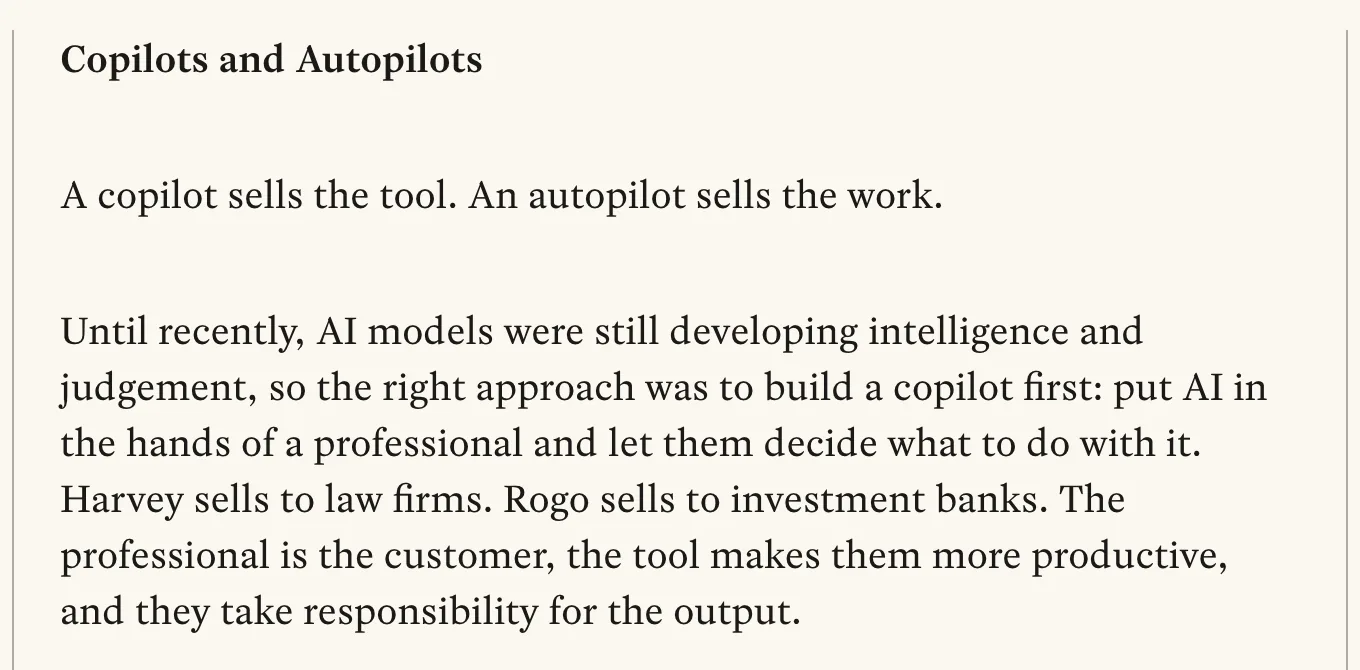
The trap is building a cleverer tool for the professional. Bek's warning is blunt: "If you sell the tool, you're in a race against the model." Each model upgrade makes your feature easier to copy. Sell the finished work and the same upgrade makes your service quicker and cheaper to deliver.
The 3 steps
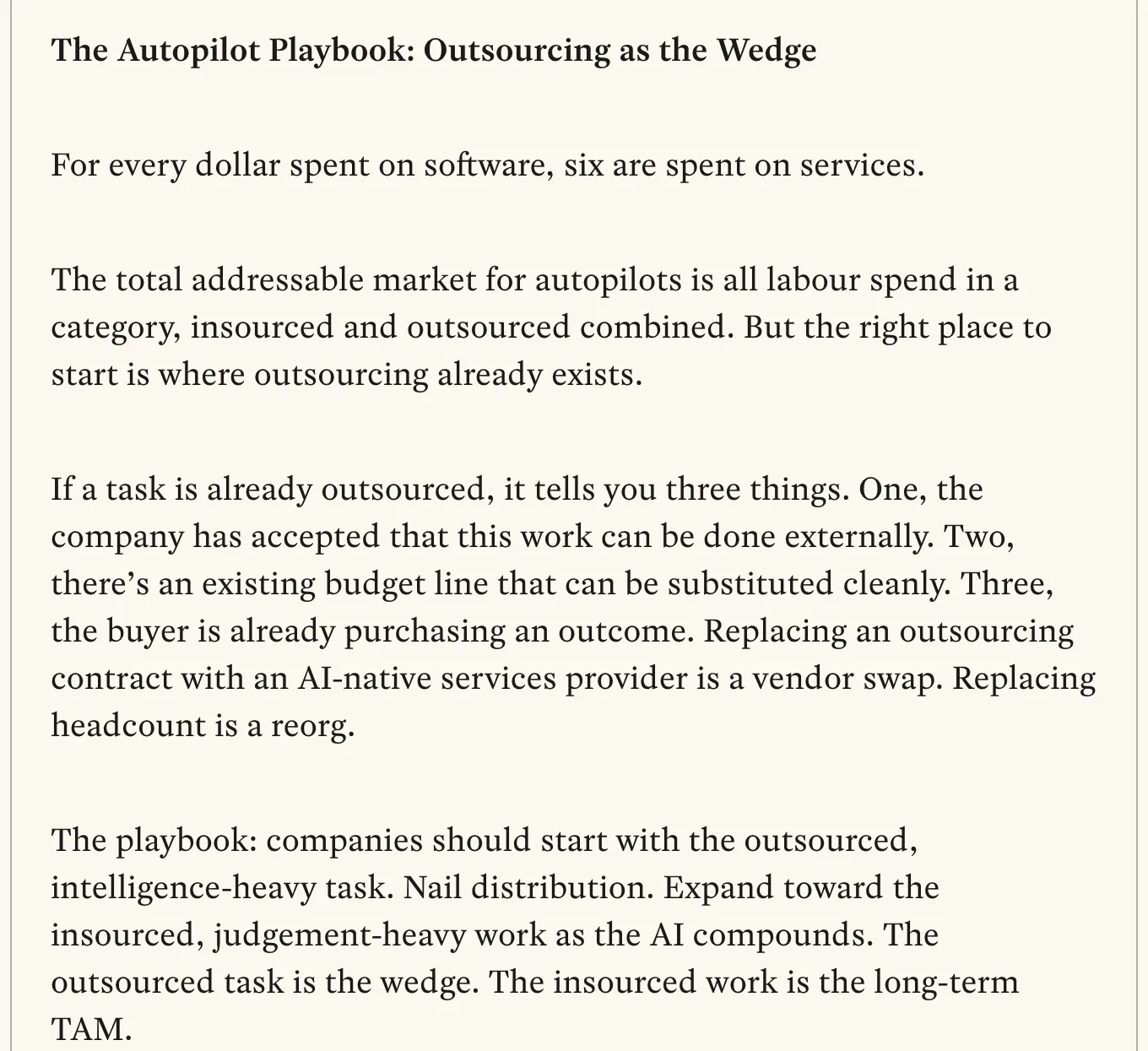
Sequoia's answer: "start with the outsourced, intelligence-heavy task." Bek splits work into two kinds. Intelligence has a right answer. Judgement needs taste. "Writing code is mostly intelligence. Knowing what to build next is judgement."
Outsourced matters because, as he puts it, an outsourced task tells you three things. The company has accepted the work can be done outside. There's "an existing budget line that can be substituted cleanly." The buyer is already purchasing an outcome. Replacing an outsourcing contract is a vendor swap, while replacing headcount is a reorg.
Sequoia doesn't set out a pricing formula, so this part is my method. Bek's rule behind it is simple: "The work budget in any profession dwarfs the tool budget." You price against the service invoice, never against the software.
Take Sequoia's numbers and assume, for illustration, that the $120K accountant buys twelve month-end closes. Today's price is $10K per close. Charge half that and the buyer saves $60K a year. You'd still bill six times what the same business pays QuickBooks for the whole year.
The trap is pricing against the $10K tool. Do that and you've priced the work as a feature. One more snag from Fortune: many services firms have always billed by time and some large companies' tenders still ask for an hourly rate. Keep an hourly equivalent ready so you aren't screened out.
An autopilot only works if the buyer trusts the output without redoing it. Sequoia makes the point about legal work: "The work product is standardised enough that quality is verifiable, so the buyer can trust AI output without deep legal expertise." Run your task through this checklist, which is mine, before you sell it.
Checks 1 and 2 are non-negotiable. If either is a no, it isn't an autopilot yet. Sell it as a copilot for now, keep a professional responsible for the output and come back when the result is something the buyer can see for themselves.
This week, pick one buyer you know well. List what they pay outside firms for, mark each job intelligence or judgement, then take the narrowest one through the pricing steps and the checklist. If it passes checks 1 and 2, you've found your first autopilot.
How I use it. At Techlerator I build Xeruit, an AI talent intelligence platform, so recruiting is the category I know best. When I'm deciding what to build next I run each idea through the three questions in this playbook. Does a company already pay an outside firm for it? Is it mostly intelligence, like screening and matching, or judgement, like closing a candidate? Can the client see it's done without me explaining it? If that last answer is fuzzy, the idea waits. I've automated most of my own startup with AI agents and I judge each one the same way: on a finished job I can check, whether that's a brief written, an inbox sorted or a draft ready for my review.
What this won't do: it won't hand you a business. Sequoia's thesis is one investor's view of where the money is going. Selling outcomes means you carry the cost of every job that goes wrong. Audit, tax and legal work have licensing rules, so a qualified person still signs off. The prices here are illustrations, not financial advice.
Stop pricing against the software. Price against the invoice.
Sources, opened 4 November 2026: Julien Bek, Sequoia Capital, Services: The New Software (5 March 2026); Jeremy Kahn, Fortune, Eye on AI (21 April 2026). The pricing method and the checklist are my own.
The Audacity to Build is my community for people doing exactly that. It is opening soon. Join the waitlist and you are first in when it does.
If this was useful, follow me. I share what I am actually building, the tools that survive my own testing, and the ones I quietly cancel. New plays every week.
Pop in your name and email and the guide is yours, along with the occasional new guide when I publish one. No spam, ever.